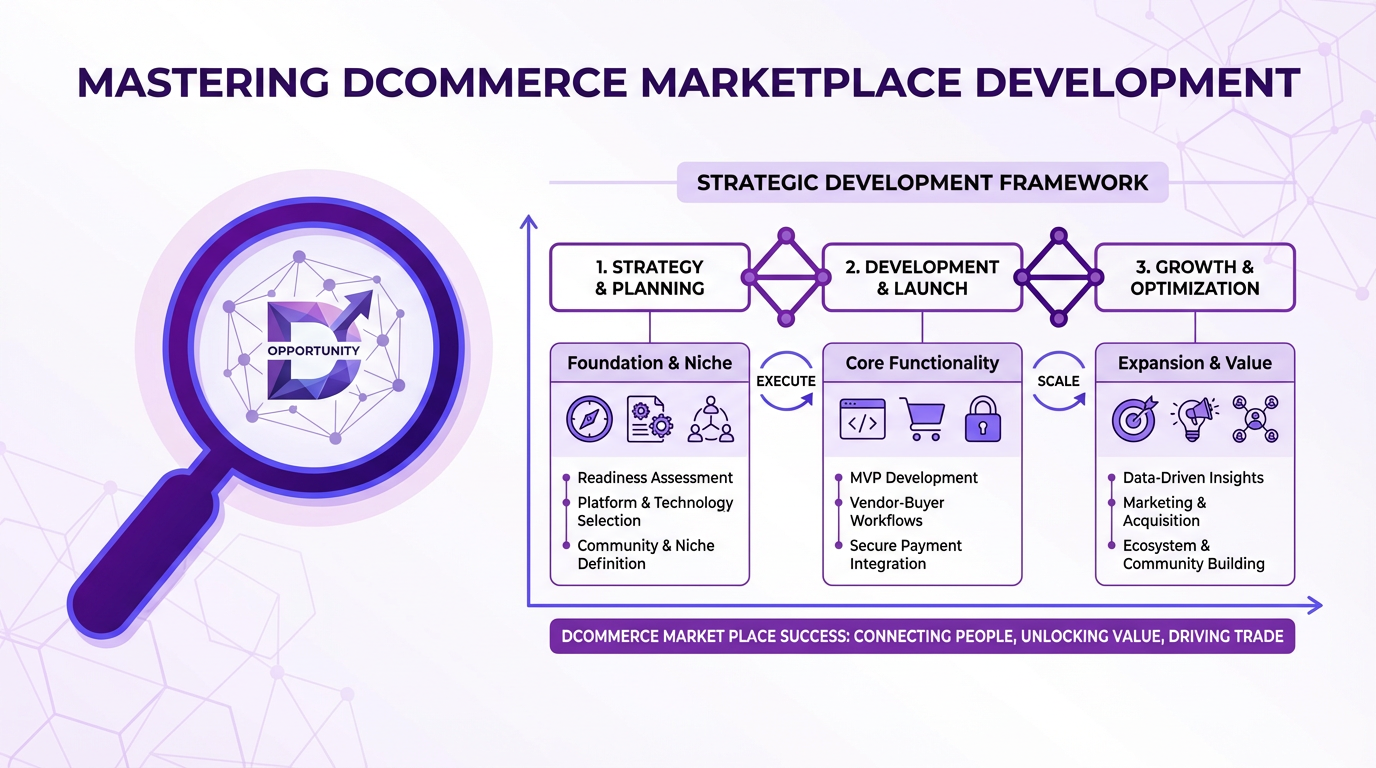
Mastering Dcommerce Marketplace Development: A Strategic Guide
Mastering Dcommerce Marketplace Development: A Strategic Guide
Dcommerce marketplace development is at the forefront of the decentralized economy, offering a new paradigm for online commerce that prioritizes transparency, user ownership, and censorship resistance. Unlike traditional centralized marketplaces, Dcommerce platforms leverage blockchain technology to create peer-to-peer environments where transactions are direct, secure, and often governed by smart contracts. This guide delves into the strategic considerations and technical pathways for building robust and scalable decentralized marketplaces, a critical component of the broader movement towards Decentralized Commerce Platforms.The allure of Dcommerce marketplaces lies in their ability to eliminate intermediaries, reduce fees, and provide greater control to both buyers and sellers. This shift not only democratizes access to global markets but also fosters innovative business models, such as those seen in the creator economy. As the digital landscape evolves, understanding the nuances of Dcommerce marketplace development becomes essential for businesses aiming to stay competitive and embrace the future of online trade.
Key Dcommerce Marketplace Statistics • The total value locked (TVL) in decentralized finance (DeFi) protocols, which often underpin Dcommerce, exceeded $100 billion in 2023, indicating significant capital flow. • Over 1.5 million unique active wallets interacted with Dapps (decentralized applications) daily in Q3 2023, showcasing growing user engagement. • Transaction fees on some Dcommerce platforms can be up to 90% lower than traditional marketplaces due to the absence of central intermediaries. • The global blockchain market, a foundational technology for Dcommerce, is projected to grow from $11.1 billion in 2022 to $469.4 billion by 2030.
Understanding the Dcommerce Marketplace Ecosystem
Developing a Dcommerce marketplace requires a deep understanding of its underlying ecosystem, which is fundamentally different from traditional e-commerce. At its core, a Dcommerce marketplace is built on a blockchain, utilizing smart contracts to automate agreements and transactions. This eliminates the need for trusted third parties, making processes more efficient and less prone to fraud.Key components of this ecosystem include decentralized identity solutions, secure payment gateways (often cryptocurrency-based), and robust data storage mechanisms. The choice of blockchain protocol – whether Ethereum, Solana, Polygon, or others – significantly impacts scalability, transaction costs, and the overall user experience. This foundational decision is crucial for the long-term viability and success of the marketplace, especially when considering Interoperability in Dcommerce ecosystems.
Strategic Considerations for Platform Selection
Selecting the right blockchain and associated tools is perhaps the most critical initial step in Dcommerce marketplace development. Factors such as transaction speed, gas fees, developer community size, and existing infrastructure play a pivotal role. A platform designed for high-volume transactions might be ideal for a general goods marketplace, while one optimized for digital assets could be better suited for an NFT marketplace platforms.| Platform Feature | Best For | Scalability | Cost Efficiency | Developer Support |
|---|---|---|---|---|
| Ethereum (L2s) | High security, broad ecosystem | Medium (via L2s) | Medium-High | Excellent |
| Solana | High throughput, low fees | Very High | Very Low | Good |
| Polygon | Ethereum compatibility, low fees | High | Low | Good |
| Cardano | Research-driven, secure | Medium | Medium | Growing |
The Development Lifecycle: From Concept to Launch
The development of a Dcommerce marketplace follows a structured lifecycle, albeit with unique considerations for decentralized technologies. It begins with a clear definition of the marketplace's purpose, target audience, and unique value proposition. This initial phase is crucial for designing a user experience that is intuitive and accessible, even for those new to blockchain technology.Technical development involves smart contract creation, front-end user interface (UI) design, and integration with various decentralized services. Security audits of smart contracts are non-negotiable, as vulnerabilities can lead to significant financial losses. Post-launch, continuous monitoring, community engagement, and iterative improvements are vital for sustained growth and user satisfaction.
6-Step Dcommerce Marketplace Development Framework
Ensuring Security and Trust in a Trustless Environment
Security is paramount in Dcommerce marketplace development. While blockchain technology offers inherent security advantages, smart contract vulnerabilities remain a significant risk. Rigorous auditing by multiple independent firms is essential to identify and mitigate potential exploits. Furthermore, implementing robust dispute resolution mechanisms, often through decentralized arbitration, builds trust among users.Expert Insight: "Many Dcommerce marketplace projects focus heavily on the 'decentralized' aspect but overlook the 'commerce' fundamentals. A truly successful Dcommerce marketplace isn't just technically sound; it's also designed with user experience, dispute resolution, and effective governance in mind. Without these, even the most innovative blockchain tech won't attract and retain users. The human element of trust, even in a trustless system, cannot be underestimated."Beyond smart contract security, protecting user data and ensuring privacy are critical. Solutions like Privacy-preserving Dcommerce are gaining traction, allowing users to transact and interact without revealing unnecessary personal information. This focus on privacy not only enhances security but also aligns with the core ethos of decentralization.
Diagram: Dcommerce Marketplace Transaction Flow [Seller Lists Item (Smart Contract)] → [Buyer Finds Item & Initiates Purchase] → [Funds Locked in Escrow (Smart Contract)] → [Item Delivered & Verified] → [Funds Released to Seller (Smart Contract)] → [Feedback & Reputation Update]
The Future of Dcommerce Marketplaces
The landscape of Dcommerce marketplace development is rapidly evolving. We are seeing a move towards more specialized marketplaces catering to niche communities, as well as the emergence of sophisticated tools for Decentralized storefront builders. The integration of AI and machine learning for personalized recommendations and fraud detection, while maintaining decentralized principles, is also on the horizon.Another key area of growth is the development of cross-chain Dcommerce solutions, allowing marketplaces to operate seamlessly across different blockchain networks. This will significantly expand the reach and liquidity of decentralized markets, breaking down the silos that currently exist between various blockchain ecosystems. The potential for Dcommerce to revolutionize global trade, particularly for underserved communities, is immense, solidifying its role as a cornerstone of future Decentralized Commerce Platforms.
Frequently Asked Questions
What is the primary difference between a Dcommerce marketplace and a traditional online marketplace?
A Dcommerce marketplace operates on a blockchain, using smart contracts to automate transactions and remove intermediaries, providing greater transparency, lower fees, and user ownership. Traditional marketplaces are centralized, controlled by a single entity, and rely on trusted third parties for transactions.How are disputes resolved in a Dcommerce marketplace?
Disputes in Dcommerce marketplaces are typically resolved through decentralized arbitration mechanisms, where a community of arbitrators or a predefined smart contract logic mediates disagreements. This ensures fairness and reduces reliance on a central authority.What are the main challenges in Dcommerce marketplace development?
Key challenges include ensuring smart contract security, achieving scalability on blockchain networks, designing intuitive user experiences for a new technology, and fostering a strong, engaged community for governance and adoption.Key Takeaways
- Dcommerce marketplace development leverages blockchain and smart contracts to create transparent, peer-to-peer commerce environments.
- Strategic platform selection, considering factors like scalability and cost, is crucial for long-term success.
- The development lifecycle emphasizes robust smart contract design, rigorous security audits, and continuous community engagement.
- Security and trust are built through transparent code, decentralized dispute resolution, and privacy-preserving technologies.
- The future holds specialized marketplaces, AI integration, and cross-chain solutions, expanding the reach and functionality of decentralized commerce.