Decentralized Autonomous Organizations for Retail: The Future of Shopping
Decentralized Autonomous Organizations for Retail: The Future of Shopping
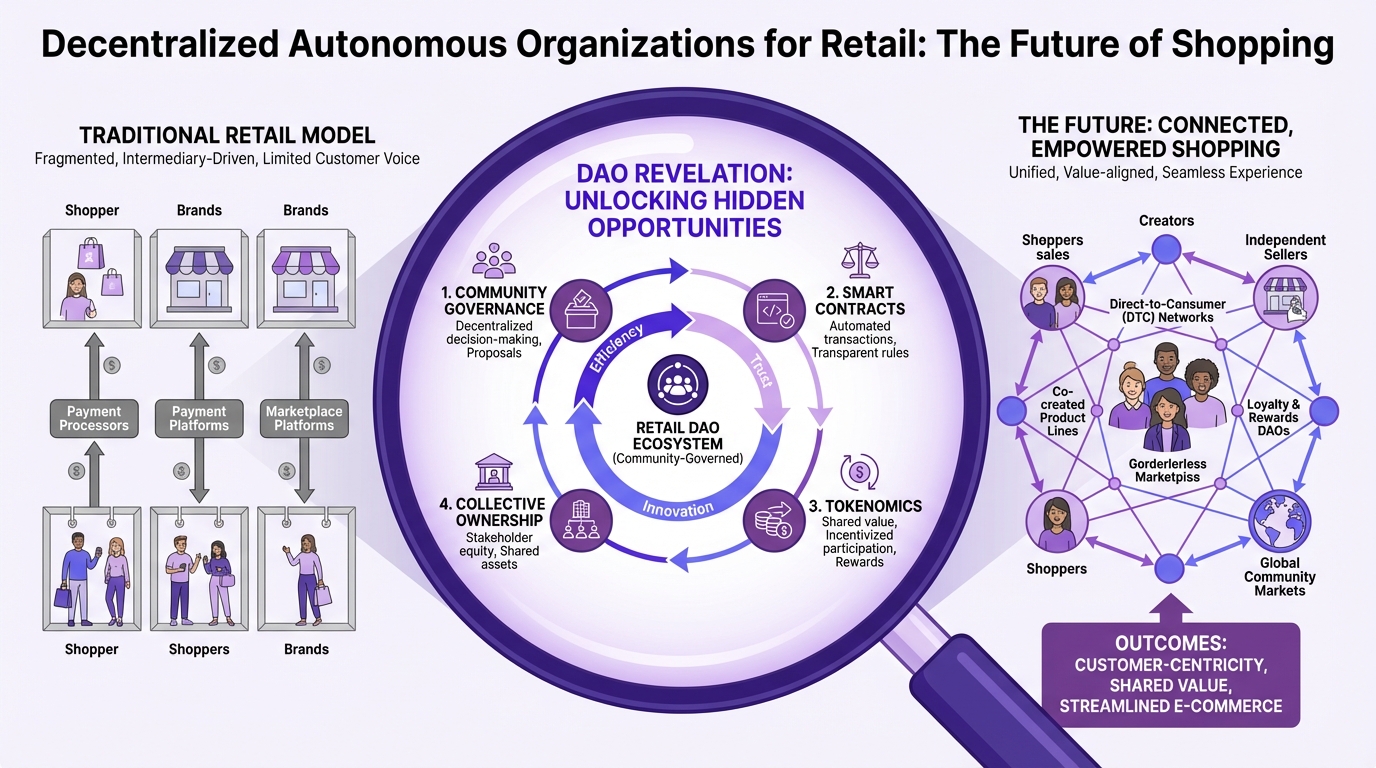
The retail industry, long dominated by centralized corporations and traditional supply chains, is on the cusp of a transformative shift with the emergence of Decentralized Autonomous Organizations (DAOs) for retail. These innovative structures leverage blockchain technology to create transparent, community-governed shopping experiences, fundamentally redefining how products are sourced, sold, and managed. For businesses looking to innovate within the broader spectrum of Dcommerce Business Models, understanding the potential of DAOs in retail is no longer optional, but essential for future relevance.DAOs for retail envision a world where consumers, suppliers, and even product designers collectively own and operate online stores or marketplaces. This model promises greater transparency, fairer pricing, and a more direct connection between producers and consumers, cutting out many traditional intermediaries. By encoding rules and processes into smart contracts, these DAOs can automate operations, manage treasuries, and facilitate collective decision-making, leading to a more efficient and equitable retail ecosystem.
Key DAO Retail Statistics • Early DAO-backed retail initiatives have reported up to 40% lower operational overhead due to automation and reduced intermediaries. • Consumer trust in transparent, community-governed retail platforms is 2x higher than in traditional e-commerce giants. • Over $500 million has been allocated by DAOs towards various commercial and retail-focused ventures in the past year. • Retail DAOs leveraging tokenized loyalty programs have seen customer engagement rates increase by an average of 35%.
How DAOs are Reshaping the Retail Landscape
DAOs introduce several disruptive elements to the retail sector, challenging established norms and creating new opportunities for both businesses and consumers. Their impact spans from product development and supply chain management to customer service and marketing.Decentralized Product Curation and Sourcing
Instead of a central buying team, a retail DAO can empower its community to propose, vote on, and even source products. This allows for highly niche and community-driven product offerings that directly reflect the desires of the customer base. Smart contracts can automate supplier agreements and payment, ensuring transparency and efficiency in the sourcing process. This approach aligns with the principles of Open-source commerce platforms, where collective input drives innovation.| Retail Function | Traditional Approach | DAO Retail Approach | Key Advantage |
|---|---|---|---|
| Product Curation | Centralized buying team | Community proposals & voting | Hyper-relevant inventory, direct consumer input |
| Supply Chain | Opaque, multi-layered | Blockchain-verified, transparent | Traceability, ethical sourcing |
| Pricing Strategy | Corporate decision | Community-governed proposals | Fairer pricing, dynamic adjustments |
| Marketing | Top-down campaigns | Community-driven advocacy | Authentic engagement, viral growth |
Community Governance in Retail Operations
At the heart of a retail DAO is its governance model, which allows token holders to collectively make decisions about the store's operations. This could include voting on which products to stock, setting pricing policies, determining marketing strategies, or even deciding on the allocation of profits. This level of Community ownership in commerce fosters a strong sense of belonging and ensures that the retail platform truly serves its community.7-Step Framework for Launching a Retail DAO
Building a successful retail DAO requires a strategic blend of community engagement, technical infrastructure, and a clear value proposition.The Role of Transparency and Trust
One of the most significant advantages of DAOs in retail is the inherent transparency provided by blockchain technology. Every transaction, every governance vote, and every treasury allocation is recorded on an immutable ledger, accessible to all. This eliminates information asymmetry and builds unparalleled trust among participants, a critical factor in today's consumer landscape.Expert Insight: "The biggest hurdle for retail DAOs isn't technology; it's cultural. Convincing consumers and suppliers to trust a decentralized, community-governed entity over a familiar brand requires a fundamental shift in mindset. Education, transparent communication, and consistently delivering on the promise of shared value are paramount to overcoming this."
Future Implications for Retail
DAOs for retail are poised to disrupt various aspects of the industry, from luxury goods with Fractional ownership of assets in commerce to everyday consumables. They offer a pathway to more ethical supply chains, direct-to-consumer models that empower creators, and highly personalized shopping experiences driven by collective intelligence. As these models mature, they will likely lead to a more fragmented yet resilient retail landscape, where niche communities can build and sustain their own commercial ecosystems, a key evolution in leading Dcommerce Business Models.Diagram: Retail DAO Decision Flow [Community Member Proposal (e.g., New Product)] → [Governance Token Holders Vote] → [Smart Contract Executes Decision] → [Supplier Onboarding/Product Listing] → [Sales & Revenue Generation] → [Treasury Allocation (Community Vote)] → [Feedback Loop to Community]
Frequently Asked Questions
What is a Decentralized Autonomous Organization (DAO) in the context of retail?
A DAO for retail is an online store or marketplace governed by its community members through smart contracts on a blockchain, rather than a central authority. Members use governance tokens to vote on decisions like product selection, pricing, and treasury management.How do DAOs improve transparency in retail?
DAOs improve transparency by recording all transactions, governance votes, and treasury movements on a public, immutable blockchain ledger. This allows any participant to verify operations, eliminating information asymmetry and fostering trust.Can DAOs manage physical product inventory and logistics?
Yes, DAOs can manage physical product inventory and logistics by integrating with existing third-party fulfillment services and supply chain partners. The decentralized aspect primarily governs the platform's decision-making and financial operations, while physical handling can be outsourced or managed by a trusted sub-DAO.What are the benefits for consumers participating in a retail DAO?
Consumers benefit from having a direct voice in product offerings and store policies, potentially fairer pricing, access to unique community-curated products, and often a financial stake in the platform's success through governance tokens or revenue sharing.What challenges do retail DAOs face?
Challenges include regulatory uncertainty, achieving sufficient community engagement for effective governance, managing the complexities of physical logistics in a decentralized manner, and ensuring the security of smart contracts against vulnerabilities.Key Takeaways
- Retail DAOs leverage blockchain for transparent, community-governed shopping experiences.
- They enable decentralized product curation, sourcing, and operational decision-making.
- Community ownership and governance tokens are central to their structure and success.
- Transparency and trust are significantly enhanced through blockchain's immutable ledger.
- While facing challenges, retail DAOs promise a more equitable and efficient future for the retail industry.
Join a Global Community of Decentralized Shoppers and Creators
Experience a shopping ecosystem built on transparency and decentralization today.