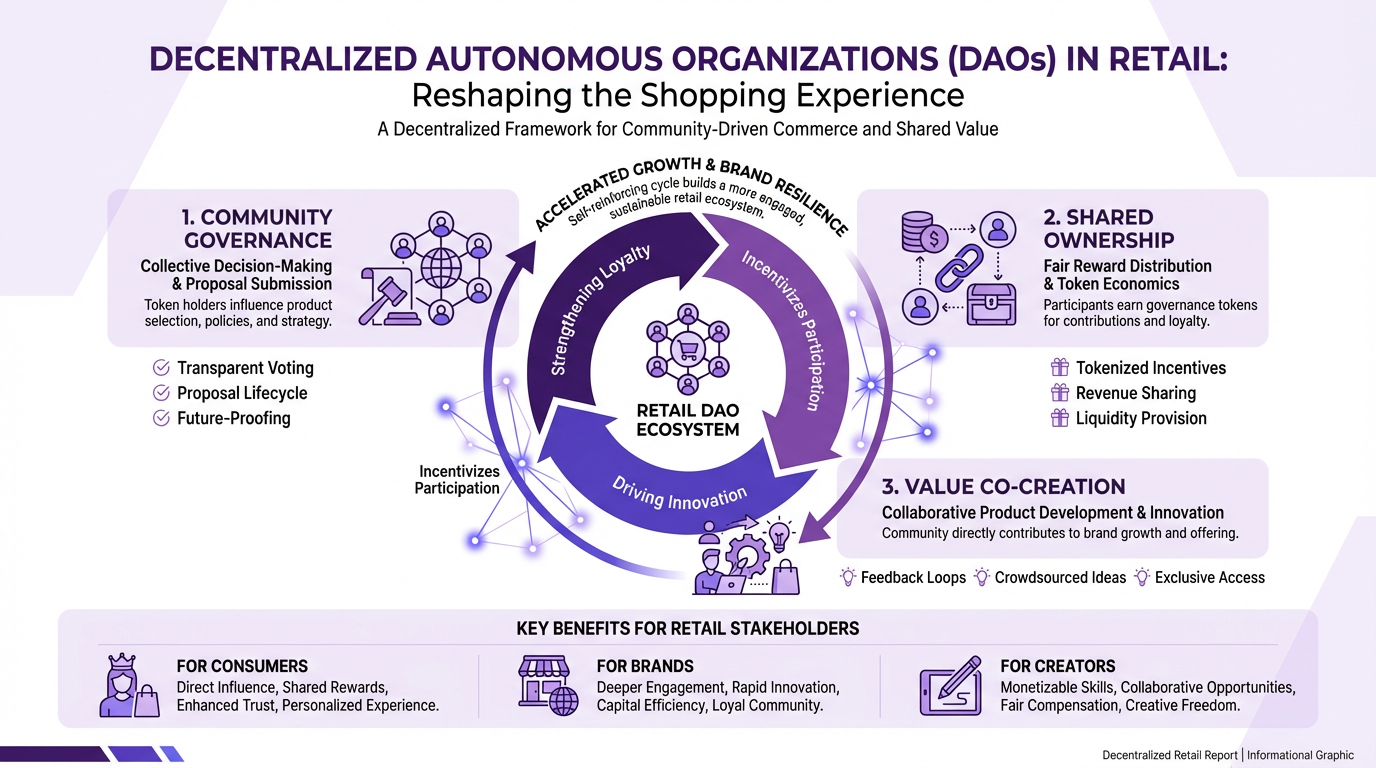
Decentralized Autonomous Organizations for Retail: Reshaping the Shopping Experience
Decentralized Autonomous Organizations for Retail: Reshaping the Shopping Experience
Decentralized Autonomous Organizations (DAOs) are poised to revolutionize the retail sector by introducing unprecedented levels of transparency, community governance, and shared ownership. Moving beyond traditional e-commerce, decentralized autonomous organizations for retail empower consumers, suppliers, and creators to collectively shape the shopping experience, from product curation to revenue distribution. This innovative approach promises to create more equitable, efficient, and resilient retail ecosystems, fundamentally altering the competitive landscape and offering new avenues for value creation within various Dcommerce Business Models.Key DAO in Retail Statistics • Over 60% of Gen Z consumers express a preference for brands with transparent and ethical supply chains, a core tenet of DAOs. • Early adopters of DAO-like retail models report a 20% increase in customer loyalty and repeat purchases. • The global retail market is projected to reach over $30 trillion by 2025, with decentralized models capturing an increasing share. • Projects leveraging DAO governance for product selection have seen a 15% reduction in inventory waste due to better alignment with community demand.
The Promise of Decentralized Retail
Traditional retail often suffers from opacity, centralized control, and a disconnect between brands and consumers. DAOs address these issues by leveraging blockchain technology to create a transparent, community-governed framework. In a DAO-powered retail environment, decisions about product lines, pricing strategies, marketing campaigns, and even treasury management can be put to a vote by token holders, who are often the very customers and contributors of the platform.How DAOs Transform Retail Operations
DAOs can impact various facets of retail, from sourcing and supply chain management to customer service and brand development. By decentralizing these functions, DAOs can foster greater efficiency, reduce overheads, and build a stronger, more engaged community around the retail brand.| Retail Function | DAO Transformation | Traditional Approach | Benefits of DAO |
|---|---|---|---|
| Product Curation | Community Voting | Buyer/Merchandiser | Demand-driven, reduced risk |
| Supply Chain | Blockchain Traceability | Opaque, Centralized | Transparency, ethical sourcing |
| Marketing | Community-led Campaigns | Agency-driven | Authentic, cost-effective |
| Customer Service | Peer-to-Peer Support | Centralized Call Center | Faster, more empathetic |
Building a Retail DAO: Core Components
Establishing a successful retail DAO requires careful consideration of several core components. These include a robust tokenomics model that incentivizes participation, a clear governance framework, and smart contracts that automate key retail processes. The goal is to create a self-sustaining ecosystem where all stakeholders are aligned towards the common goal of a thriving retail platform.5-Step Retail DAO Implementation Framework
The Impact on Consumer Experience and Trust
Decentralized autonomous organizations for retail have the potential to significantly enhance the consumer experience. By offering transparency into product origins, allowing direct input on product development, and providing a stake in the platform's success, DAOs can build unparalleled levels of trust and loyalty. Consumers become more than just buyers; they become co-creators and co-owners, leading to a more personalized and engaging shopping journey.Expert Insight: "The future of retail isn't just about faster delivery or cheaper prices; it's about authenticity and alignment. DAOs provide the technological and organizational framework to deliver both, creating brands that consumers don't just buy from, but truly belong to."This enhanced trust is particularly valuable in an era where consumers are increasingly wary of corporate practices and demand greater accountability. DAOs, with their inherent transparency, can meet this demand head-on.
Diagram: Retail DAO Customer Journey [Customer Discovery] → [Community Product Curation] → [Transparent Purchase via Smart Contract] → [Community Feedback & Support] → [Governance Participation & Rewards] → [Enhanced Loyalty & Advocacy]
Challenges and the Future Outlook
While the concept of retail DAOs is compelling, challenges remain. These include navigating complex regulatory environments, ensuring user-friendly interfaces for non-technical users, and scaling operations while maintaining decentralization. The legal recognition of DAOs is still evolving, which can create hurdles for traditional business operations.However, the rapid development of Web3 infrastructure, coupled with increasing consumer demand for ethical and transparent commerce, suggests a bright future for decentralized autonomous organizations in retail. We can anticipate the emergence of specialized retail DAOs, perhaps focusing on subscription models in Dcommerce for curated goods or even rental models in Dcommerce for high-value items, all governed by their communities. These innovations will continue to push the boundaries of what's possible within the broader spectrum of Dcommerce Business Models.
Frequently Asked Questions
What are Decentralized Autonomous Organizations (DAOs) in retail?
Decentralized Autonomous Organizations (DAOs) in retail are blockchain-based entities that allow a community of token holders to collectively govern and operate a retail business. Decisions on product selection, pricing, and operations are made through transparent voting, rather than by a centralized management team.How do DAOs enhance transparency in the retail sector?
DAOs enhance transparency by recording all governance decisions and often supply chain data on an immutable blockchain ledger. This allows consumers and stakeholders to verify product origins, ethical practices, and how funds are managed, fostering greater trust than traditional opaque retail models.What role do customers play in a retail DAO?
In a retail DAO, customers can play a multifaceted role as token holders. They can vote on proposals, contribute to product curation, provide feedback, participate in marketing efforts, and potentially share in the platform's revenue, transforming them into active co-owners and stakeholders.Key Takeaways
- Retail DAOs leverage blockchain for transparent, community-governed shopping experiences.
- They shift control from centralized entities to a collective of consumers, suppliers, and creators.
- Benefits include enhanced trust, increased loyalty, demand-driven product curation, and efficient operations.
- Successful implementation requires robust tokenomics, clear governance, and active community engagement.
- Despite regulatory and scaling challenges, retail DAOs are poised to reshape the future of commerce with more equitable and transparent models.
Access Exclusive Dcommerce Brands and Digital Specialized Products
From Solana Deads to Blockchain Bobbles, discover the products defining the decentralized era.