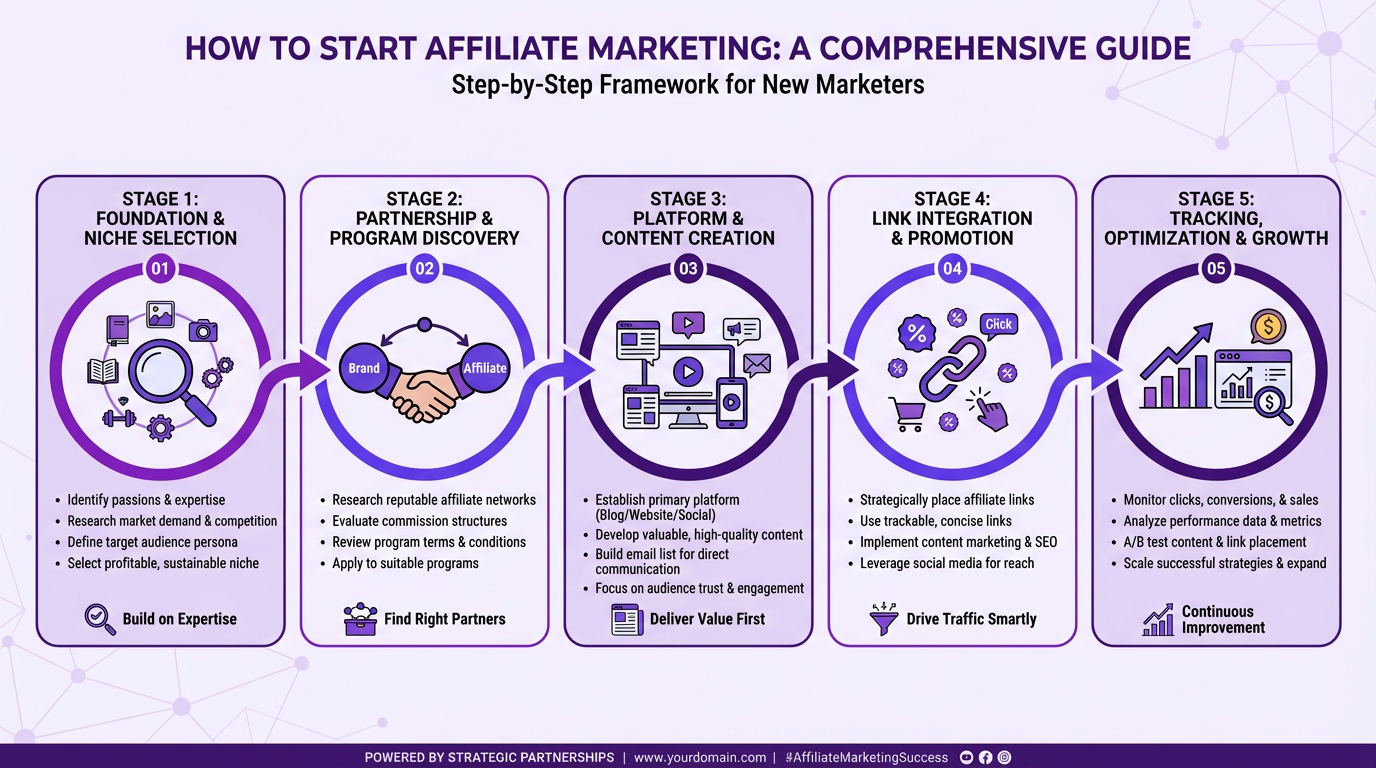
How to Start Affiliate Marketing: A Comprehensive Guide for New Marketers
How to Start Affiliate Marketing: A Comprehensive Guide for New Marketers
Starting an affiliate marketing journey can seem daunting, but with a structured approach, it's an accessible path to generating online income. This guide breaks down the essential steps for anyone looking to enter the world of affiliate marketing, from understanding the basics to optimizing for success. At its core, affiliate marketing involves promoting products or services and earning a commission for every sale or lead generated through your unique affiliate link. It's a performance-based marketing strategy that leverages the power of partnerships.Many aspiring entrepreneurs are drawn to the flexibility and potential scalability that affiliate marketing offers. Unlike traditional businesses, you don't need to create your own products, manage inventory, or handle customer service. Your primary role is to connect potential customers with valuable offerings, making it an attractive model for those seeking financial independence. Understanding the nuances of various Affiliate Marketing Programs is crucial for selecting the right partners and maximizing your earning potential.
Key Affiliate Marketing Statistics • The affiliate marketing industry is projected to reach over $17 billion by 2023, demonstrating significant growth. • Over 80% of brands leverage affiliate marketing to drive sales and customer acquisition. • Publishers using affiliate marketing generate 15-30% of their revenue from these programs. • The average commission rate for affiliate marketers ranges from 5% to 30% depending on the industry and product.
Understanding the Affiliate Marketing Ecosystem
Before diving in, it's vital to grasp the key players and their roles. The ecosystem typically involves four main parties: the merchant (or advertiser), the affiliate (or publisher), the consumer, and the affiliate network. The merchant creates the product, the affiliate promotes it, the consumer makes the purchase, and the affiliate network often acts as an intermediary, providing tracking, payment processing, and a marketplace for programs.Choosing the right niche and understanding your audience are foundational. Without a clear focus, your efforts can become diluted. Consider what you're passionate about or knowledgeable in, as this will make content creation more authentic and engaging. Researching potential products within your chosen niche is the next logical step, ensuring they align with your audience's needs and offer competitive commissions.
Key Components of an Affiliate Marketing Strategy
| Strategy Component | Best For | Difficulty | ROI Potential |
|---|---|---|---|
| Niche Selection | Focused audience targeting | Medium | High |
| Audience Research | Understanding pain points & desires | Medium | High |
| Content Creation | Engaging & valuable promotion | Medium/Hard | Very High |
| Traffic Generation | Reaching potential customers | Hard | High |
| Conversion Optimization | Maximizing sales from traffic | Medium | High |
The 7-Step Framework to Launch Your Affiliate Marketing Business
Launching a successful affiliate marketing venture requires more than just signing up for a program. It demands strategic planning and consistent execution. This framework outlines the critical steps to get you started on the right foot.7-Step Affiliate Marketing Launch Framework
Selecting the Right Affiliate Programs and Products
Not all affiliate programs are created equal. The choice of programs and products can significantly impact your success. Look for products that genuinely solve a problem for your target audience and have a strong reputation. High-ticket items often offer larger commissions per sale, while lower-priced items might offer higher volume. Consider recurring commissions for subscription-based services, which can provide a stable income stream.When evaluating programs, pay attention to the cookie duration – this is how long a customer's click on your link is tracked. A longer cookie duration means you have more time to earn a commission if the customer makes a purchase later. Also, examine the support offered by the merchant; good support can be invaluable for resolving issues and accessing promotional materials.
Expert Insight: "Don't chase every high-commission product. Focus on relevance and quality first. Promoting something you genuinely believe in, even if the commission is slightly lower, will always outperform pushing a product solely for its payout. Authenticity builds trust, and trust drives long-term conversions."
Building Your Affiliate Marketing Website
While not strictly necessary for all forms of affiliate marketing, a dedicated website provides a central hub for your content and offers the most control. It allows you to build an audience, establish authority, and implement advanced SEO strategies. When considering Building an affiliate marketing website, focus on user experience, mobile responsiveness, and clear navigation. Your website is your digital storefront, and its design and functionality directly impact your credibility and conversion rates.Diagram: Affiliate Marketing Success Loop [Niche Selection] → [Content Creation] → [Traffic Generation] → [Conversion] → [Commission Earned] → [Analysis & Optimization] → [Feedback Loop to Niche Selection (for expansion/refinement)]
Driving Traffic and Optimizing Conversions
Generating traffic is the lifeblood of affiliate marketing. Without visitors, there are no clicks, and without clicks, there are no commissions. SEO (Search Engine Optimization) is a long-term strategy that involves optimizing your content to rank higher in search engine results. Social media marketing can provide immediate traffic, especially if you have an engaged audience. Email marketing allows for direct communication with your subscribers, offering a highly effective channel for promotions.Once traffic arrives, the goal shifts to conversion. This involves guiding visitors to click your affiliate links and make a purchase. Clear calls to action, compelling product reviews, and persuasive copywriting are essential. A/B testing different elements of your content, such as headlines, images, and button colors, can reveal what resonates best with your audience. Understanding your audience's pain points and offering solutions through your recommended products is key to successful conversion.
Related: Decentralized Commerce Business Models: Innovating in the Dcommerce Era
Frequently Asked Questions
What is the fastest way to start affiliate marketing?
The fastest way to start affiliate marketing is to leverage existing platforms with an audience, such as social media or YouTube, and promote products relevant to your followers. This bypasses the initial time investment of building a website from scratch, allowing for quicker content creation and promotion.Do I need a website to do affiliate marketing?
No, you do not strictly need a website to do affiliate marketing. You can promote products through social media, email lists, YouTube channels, or even podcasts. However, a website offers more control, better SEO opportunities, and a long-term asset for your business.How much money can I make with affiliate marketing?
The income potential in affiliate marketing varies widely, from a few hundred dollars a month to six or even seven figures annually. Your earnings depend on your niche, the products you promote, your traffic generation strategies, conversion rates, and the effort you put into building your business.What are common mistakes beginners make in affiliate marketing?
Common mistakes include choosing an overly broad niche, promoting too many irrelevant products, neglecting content quality, failing to track performance, and giving up too soon. Lack of patience and inconsistent effort are significant hurdles for many new affiliate marketers.Key Takeaways
- Affiliate marketing is a performance-based model where you earn commissions for promoting products.
- Successful affiliate marketing begins with choosing a profitable niche and understanding your target audience.
- Building a platform, creating high-quality content, and driving targeted traffic are crucial steps.
- Continuously tracking and optimizing your performance is essential for long-term growth and increased earnings.
- Authenticity and trust are paramount; promote products you genuinely believe in and that provide value to your audience.