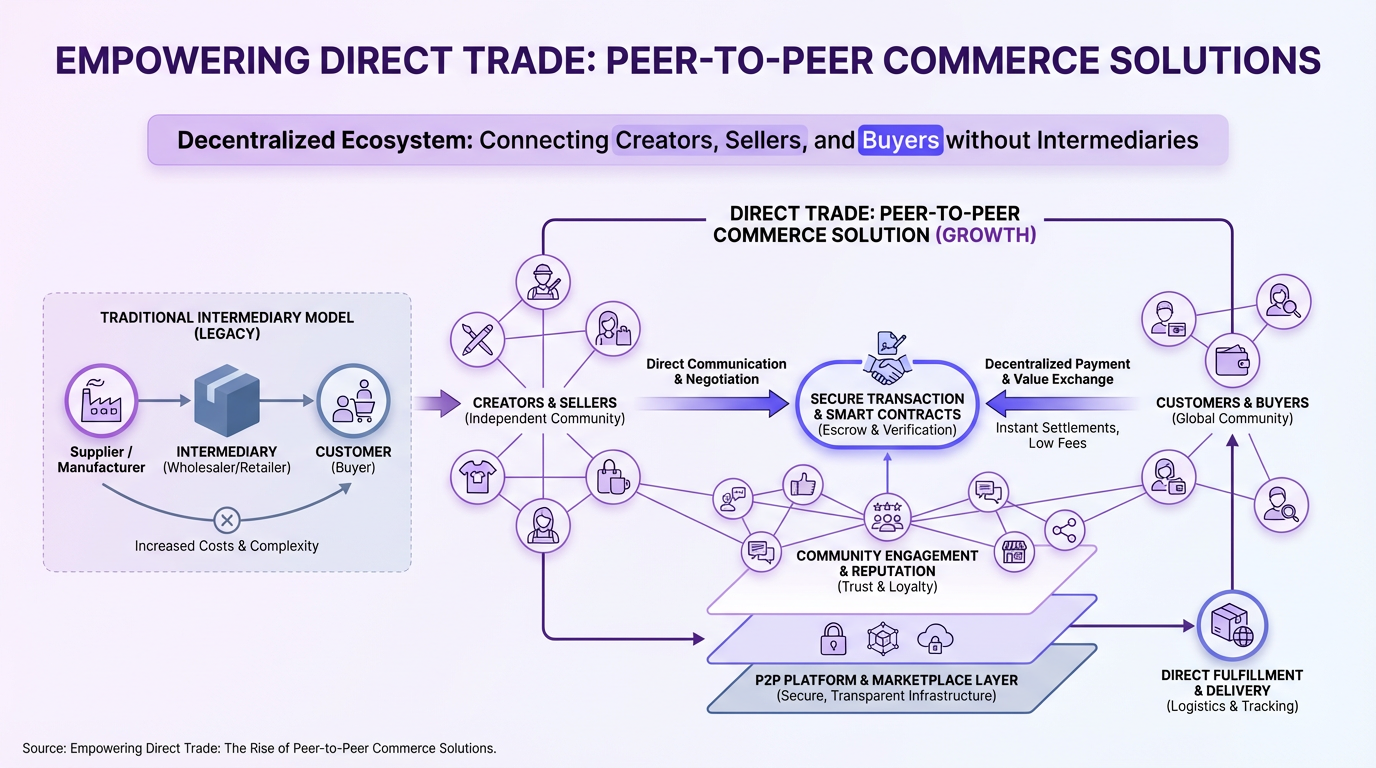
Empowering Direct Trade: The Rise of Peer-to-Peer Commerce Solutions
Empowering Direct Trade: The Rise of Peer-to-Peer Commerce Solutions
Peer-to-peer (P2P) commerce solutions are fundamentally reshaping how individuals and businesses interact in the digital marketplace. By enabling direct transactions between buyers and sellers without the need for traditional intermediaries, P2P models foster greater efficiency, transparency, and autonomy. This approach is a cornerstone of the broader movement towards Decentralized Commerce Platforms, offering a powerful alternative to centralized e-commerce giants. Understanding the mechanics and benefits of P2P commerce is crucial for anyone looking to engage with or build within the next generation of digital trade.The essence of P2P commerce lies in its disintermediation. Instead of relying on platforms that take a significant cut, control user data, and dictate terms, P2P solutions empower participants to connect and transact directly. This not only reduces costs but also enhances trust through transparent, often blockchain-verified, interactions. The rise of these solutions is a direct response to the growing demand for more equitable and user-centric economic models, where individuals have more control over their assets and data. This shift is particularly evident in the burgeoning Web3 ecosystem, where decentralization is a core tenet.
Key Peer-to-Peer Commerce Statistics • The global peer-to-peer lending market alone is projected to reach $583.4 billion by 2027, indicating a strong appetite for direct financial interactions. • Blockchain-based P2P transaction volumes increased by over 300% in emerging markets last year, driven by lower fees and greater accessibility. • Over 75% of consumers express a preference for platforms that offer greater transparency and control over their data, a key feature of P2P solutions. • P2P marketplaces can reduce transaction fees by an average of 5-15% compared to traditional platforms, directly benefiting both buyers and sellers.
The Mechanics of Peer-to-Peer Commerce
At its core, peer-to-peer commerce leverages technology to facilitate direct exchanges. In the context of decentralized commerce, this often means utilizing blockchain technology and smart contracts. When a buyer and seller agree on a transaction, a smart contract can automatically execute the terms, ensuring that funds are released only when the agreed-upon conditions (e.g., product delivery, service completion) are met. This eliminates the need for a trusted third-party escrow service, as the trust is embedded in the code itself.Furthermore, P2P solutions often incorporate decentralized identity systems, allowing users to verify their credentials without revealing excessive personal information to a central authority. This enhances privacy and reduces the risk of data breaches. The absence of a central server also means that P2P networks are inherently more resilient to censorship and downtime, providing a robust infrastructure for commerce even in challenging environments. This resilience is a significant advantage over traditional, centralized platforms that are vulnerable to single points of failure.
Key Technologies Powering P2P Commerce
The technological stack for modern peer-to-peer commerce solutions typically includes a combination of blockchain, decentralized storage, and cryptographic protocols. Blockchain provides the immutable ledger for transaction records, while decentralized storage (like IPFS) handles the secure and censorship-resistant storage of product descriptions, images, and other relevant data. Cryptographic techniques ensure the security and authenticity of communications and transactions between peers.| Technology | Best For | Difficulty | ROI Potential |
|---|---|---|---|
| Blockchain (e.g., Ethereum, Solana) | Immutable ledgers, smart contracts | Medium | High |
| Smart Contracts | Automated escrow, dispute resolution | Hard | Very High |
| Decentralized Storage (IPFS) | Censorship-resistant data hosting | Medium | Medium |
| Cryptographic Protocols | Secure communication, identity verification | Hard | High |
| P2P Networking (e.g., Libp2p) | Direct peer connections, resilience | Medium | Medium |
Benefits and Challenges of P2P Commerce
The advantages of peer-to-peer commerce solutions are numerous. For sellers, it means greater control over their listings, direct access to their customers, and often significantly lower transaction fees, leading to higher profit margins. For buyers, P2P platforms offer more transparent pricing, direct communication with sellers, and often access to unique or niche products that might not be available on larger, more curated marketplaces. The inherent censorship resistance also protects both parties from arbitrary platform decisions or account suspensions.However, P2P commerce is not without its challenges. The absence of a central authority can make dispute resolution more complex, requiring robust, on-chain arbitration mechanisms. User onboarding can also be a hurdle, as many individuals are still unfamiliar with cryptocurrency wallets and blockchain interactions. Ensuring liquidity and network effects to attract a critical mass of users is another significant challenge for new P2P platforms. Addressing these issues is crucial for the widespread adoption of Web3 commerce platforms.
5-Step P2P Commerce Solution Implementation Framework
P2P Commerce in the Broader Dcommerce Ecosystem
Peer-to-peer commerce solutions are a vital component of the larger decentralized commerce ecosystem. They often integrate with other Web3 innovations, such as NFT marketplace platforms for direct trading of unique digital assets, or Token-gated commerce experiences that allow exclusive access to products or services. The interoperability of these solutions is key, enabling seamless interaction across different decentralized applications and blockchains.As the concept of Sustainable Dcommerce models gains traction, P2P solutions are particularly well-suited to support them. By cutting out intermediaries, they inherently reduce the carbon footprint associated with centralized data centers and extensive logistics networks. Furthermore, P2P models can empower local economies and foster direct relationships between producers and consumers, contributing to more resilient and ethical supply chains.
Expert Insight: "The biggest hurdle for P2P commerce isn't the technology; it's the behavioral shift required from users. We've been conditioned for decades to trust intermediaries. Building effective reputation systems and intuitive dispute resolution mechanisms that don't rely on a central authority is paramount. It's about engineering trust into the protocol, not just the platform."
The Future Landscape of Direct Trade
The evolution of peer-to-peer commerce solutions is set to continue at a rapid pace. We can anticipate more sophisticated reputation systems, advanced Privacy-preserving Dcommerce features, and greater integration with decentralized autonomous organizations (DAOs) for collective decision-making. The development of Decentralized storefront builders will further democratize the ability for anyone to launch a P2P commerce presence, lowering the technical barrier to entry. This ongoing innovation promises a future where direct, trustless trade becomes the norm, not the exception.Diagram: Peer-to-Peer Transaction Flow [Buyer Initiates Request] → [P2P Network Matches Buyer/Seller] → [Smart Contract Escrow Initiated] → [Seller Delivers Product/Service] → [Buyer Confirms Receipt] → [Smart Contract Releases Funds to Seller]
Frequently Asked Questions
What is the primary advantage of peer-to-peer commerce solutions?
The primary advantage is the elimination of intermediaries, leading to lower transaction fees, increased transparency, greater control for users over their data and assets, and enhanced censorship resistance.How do P2P commerce solutions ensure trust without a central authority?
P2P solutions ensure trust primarily through blockchain-based smart contracts that automatically execute transaction terms, and through decentralized reputation systems that track user behavior and feedback.Are P2P commerce platforms more secure than traditional marketplaces?
They can be more secure in terms of censorship resistance and data privacy due to decentralization and cryptographic security. However, smart contract vulnerabilities or user error can still pose risks, making robust auditing crucial.What types of products or services are best suited for P2P commerce?
P2P commerce is well-suited for a wide range of products and services, including digital goods (NFTs), local services, second-hand items, and niche markets where direct interaction and lower fees are highly valued.How do P2P commerce solutions handle disputes?
Disputes in P2P commerce are typically handled through on-chain arbitration mechanisms, often involving a decentralized network of arbitrators or community-governed dispute resolution protocols, rather than a central customer service department.Key Takeaways
- Peer-to-peer commerce solutions enable direct, intermediary-free transactions, offering greater efficiency and user autonomy.
- They leverage blockchain, smart contracts, and decentralized storage for transparency, security, and censorship resistance.
- Benefits include lower fees, increased control, and enhanced privacy for both buyers and sellers.
- Challenges involve dispute resolution, user onboarding, and achieving network effects, requiring innovative decentralized approaches.
- P2P commerce is integral to the broader Dcommerce ecosystem, integrating with NFTs, token-gated experiences, and sustainable models.