SEO for Affiliate Websites: Ranking Higher & Driving Organic Sales
SEO for Affiliate Websites: Ranking Higher & Driving Organic Sales
For any affiliate marketer aiming for sustainable, long-term success, mastering search engine optimization (SEO) is not merely an advantage—it's a fundamental requirement. SEO for affiliate websites is the process of optimizing your site and its content to rank higher in search engine results pages (SERPs), thereby attracting free, highly qualified organic traffic. This traffic, unlike paid advertising, continues to flow long after your initial optimization efforts, making it a cornerstone of effective Affiliate Marketing Strategies.Without a strong SEO foundation, even the most compelling affiliate offers can remain undiscovered. By understanding and implementing key SEO principles, affiliates can position their content directly in front of users actively searching for solutions, products, or information related to their niche. This targeted visibility translates directly into increased clicks, conversions, and ultimately, greater affiliate commissions.
Key SEO Statistics for Affiliates • Organic search drives 53% of all website traffic, making it the largest channel for discovery (BrightEdge). • The first organic search result on Google receives an average click-through rate (CTR) of 28.5% (Sistrix). • 68% of online experiences begin with a search engine, underscoring the importance of visibility (BrightEdge). • Businesses that blog generate 434% more indexed pages, leading to more search visibility (TechClient).
Foundational SEO Pillars for Affiliate Success
Effective SEO for affiliate websites rests on several interconnected pillars: technical SEO, on-page SEO, off-page SEO, and content quality. Neglecting any one of these can significantly hinder your ranking potential. A holistic approach ensures that search engines can easily crawl, index, and understand your site's content, while users find it valuable and trustworthy.Technical SEO: Ensuring Your Site is Search Engine Friendly
Technical SEO deals with the backend elements of your website that impact its search engine visibility. This includes site speed, mobile-friendliness, site architecture, and crawlability. A technically sound website provides a better user experience and makes it easier for search engine bots to navigate and index your content.| Technical SEO Aspect | Best For | Difficulty | ROI Potential |
|---|---|---|---|
| Site Speed Optimization | User experience, lower bounce rates, improved rankings | Medium | High |
| Mobile Responsiveness | Reaching mobile users, Google's mobile-first indexing | Easy | Very High |
| XML Sitemaps | Guiding search engines to all important pages | Easy | Medium |
| SSL Certificate (HTTPS) | Security, trust, minor ranking boost | Easy | Medium |
On-Page SEO: Optimizing Your Content for Keywords
On-page SEO refers to all the optimizations you can make directly on your website's pages to improve their search engine rankings. This includes strategic keyword placement, compelling meta descriptions, and well-structured content. The goal is to signal to search engines what your content is about and why it's the best resource for a given query.6-Step On-Page SEO Framework for Affiliate Content
Off-Page SEO: Building Authority and Trust
Off-page SEO encompasses all activities performed outside of your website to improve its search engine ranking. The most significant factor here is backlinks—links from other reputable websites pointing to yours. Backlinks act as 'votes of confidence' from other sites, signaling to search engines that your content is valuable and trustworthy.Expert Insight: "Many affiliate marketers get stuck chasing low-quality backlinks or spamming forums. A more sustainable and effective approach is to focus on creating truly exceptional content that earns backlinks naturally. Think about what kind of content other sites in your niche would genuinely want to link to – comprehensive guides, unique data, or insightful analyses. This 'linkable asset' strategy is far more powerful than any quick-fix backlink scheme."
Strategies for Earning High-Quality Backlinks
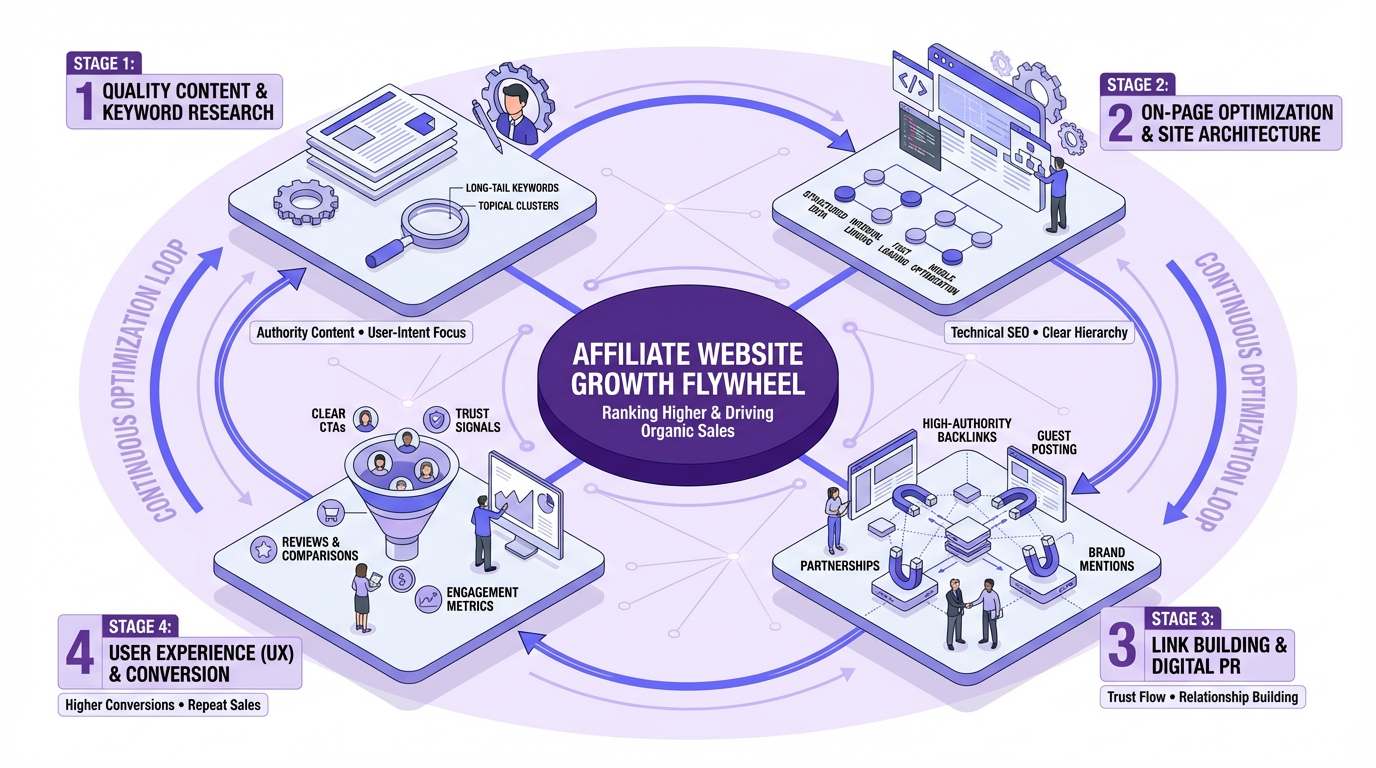
Earning high-quality backlinks requires effort and a strategic approach. Guest posting on relevant industry blogs, creating shareable infographics, conducting original research, and building relationships with influencers are all effective tactics. Remember, quality trumps quantity when it comes to backlinks.Diagram: Affiliate SEO Feedback Loop Keyword Research → Content Creation → On-Page Optimization → Link Building (Off-Page) → Rank Tracking → Content Refinement → (Loop back to Keyword Research)
The Role of Content Quality in Affiliate SEO
While technical and on-page optimizations are crucial, the ultimate determinant of long-term SEO success for affiliate websites is the quality and relevance of your content. Google's algorithms are increasingly sophisticated, prioritizing content that genuinely satisfies user intent and provides comprehensive answers. This aligns perfectly with the principles of Content marketing for affiliates.For instance, when writing Product review strategies for affiliates, ensure your reviews are unbiased, detailed, and include real-world usage scenarios. Don't just list features; explain benefits and potential drawbacks. This level of detail not only helps your audience make informed decisions but also signals to search engines that your content is a valuable resource. By focusing on user experience and providing genuine value, you naturally improve your SEO performance and drive more conversions, a key element of successful Affiliate Marketing Strategies.
Frequently Asked Questions
How long does it take to see SEO results for an affiliate website?
SEO is a long-term strategy. While some initial improvements might be seen within a few weeks, significant ranking increases and organic traffic growth typically take 3-6 months, and often longer for competitive niches. Consistency and patience are key.Is keyword stuffing still an effective SEO tactic?
No, keyword stuffing is an outdated and harmful SEO tactic. It can lead to penalties from search engines and degrades the user experience. Focus on natural language and providing value, integrating keywords organically where they make sense.Should I focus on local SEO for my affiliate website?
Generally, no, unless your affiliate offers are specifically tied to local services or products. Most affiliate marketing is global or national in scope, so your SEO efforts should focus on broader, non-local keywords. However, if you're promoting local businesses, then local SEO becomes relevant.Key Takeaways
- SEO is critical for driving free, qualified organic traffic to affiliate websites.
- A comprehensive SEO strategy includes technical, on-page, and off-page optimization.
- High-quality, user-focused content is the foundation of effective affiliate SEO.
- Backlinks from authoritative sites are crucial for building domain authority.
- SEO is a long-term investment requiring continuous effort and adaptation.