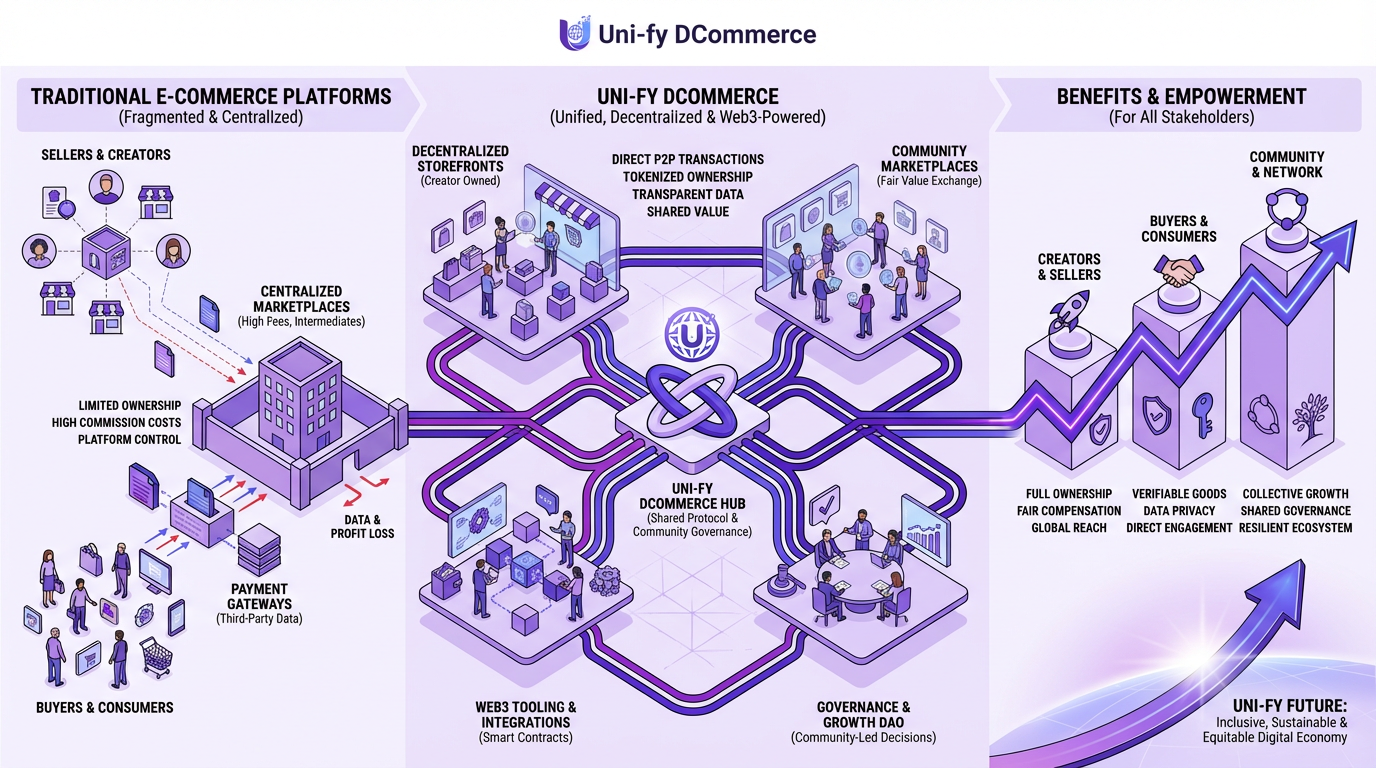
Uni-fy DCommerce: The Definitive Guide to Decentralized E-commerce and Web3
Uni-fy DCommerce: The Definitive Guide to Decentralized E-commerce and Web3
Table of Contents
- Introduction to Uni-fy DCommerce
- Understanding DCommerce: Beyond Traditional E-commerce
- The Strategic Advantages of a DCommerce Platform
- Building Your DCommerce Store with Uni-fy
- Advanced Strategies for Web3 E-commerce Success
- The Future of E-commerce: Web3 and Decentralization
- Frequently Asked Questions
- Related Guides
Introduction to Uni-fy DCommerce
The landscape of digital commerce is undergoing a profound transformation, moving beyond centralized platforms to embrace the decentralized ethos of Web3. At the forefront of this revolution is uni-fy dcommerce, a paradigm shift that redefines how businesses and consumers interact, transact, and build value online. This comprehensive guide will serve as your definitive resource for understanding uni-fy dcommerce, exploring its foundational principles, strategic implications, and practical applications within the burgeoning Web3 ecosystem. We will delve into what makes a dcommerce platform superior, how to build a dcommerce store, and the immense potential of the future of e-commerce web3.Traditional e-commerce, while ubiquitous, is often plagued by intermediaries, opaque fee structures, data privacy concerns, and a lack of true ownership for both sellers and buyers. uni-fy dcommerce offers a compelling alternative, leveraging blockchain technology to create transparent, secure, and user-centric marketplaces. This article will unpack the complexities of decentralized commerce, providing actionable insights for businesses looking to transition or expand into this innovative space. Whether you're a seasoned entrepreneur or new to the world of Web3, this guide will equip you with the knowledge to navigate and thrive in the decentralized economy.
Understanding DCommerce: Beyond Traditional E-commerce
DCommerce, or Decentralized Commerce, represents a fundamental re-imagining of online trade. Unlike traditional e-commerce platforms like Amazon or Shopify, which operate on centralized servers and control all aspects of the transaction, dcommerce leverages blockchain technology to remove intermediaries. This means transactions occur directly between buyers and sellers, governed by smart contracts, ensuring transparency, security, and immutability. The core tenets of dcommerce explained revolve around user ownership, censorship resistance, and a more equitable distribution of value.At its heart, a dcommerce platform empowers participants by giving them greater control over their data, their assets, and their interactions. This shift from platform-centric to user-centric models is a cornerstone of the Web3 movement. For businesses, this translates to lower transaction fees, direct access to customer data (with user consent), and the ability to build more resilient and community-driven marketplaces. For consumers, it means enhanced privacy, verifiable product authenticity, and a greater say in how platforms evolve. The potential for innovation in this space is vast, extending beyond simple product sales to encompass digital assets, services, and even fractional ownership of physical goods.
Key Characteristics of a DCommerce Platform
- Decentralization: No single entity controls the network or data. Transactions are peer-to-peer.
- Transparency: All transactions are recorded on a public blockchain, verifiable by anyone.
- Security: Cryptographic security protects transactions and data, reducing fraud and tampering.
- User Ownership: Users have true ownership of their digital assets and data, often managed via non-custodial wallets.
- Censorship Resistance: Platforms are less susceptible to arbitrary shutdowns or content removal by a central authority.
- Programmability: Smart contracts automate agreements and processes, enabling complex and trustless interactions.
Key DCommerce Statistics • The global blockchain market size is projected to reach over $163 billion by 2029, indicating significant infrastructure growth for dcommerce platforms. • Over 300 million people worldwide own cryptocurrency, representing a growing user base ready for Web3 commerce. • NFT sales, a precursor to digital asset commerce, reached $25 billion in 2021, demonstrating consumer appetite for blockchain-backed ownership. • Businesses adopting blockchain technology report an average of 15-20% reduction in transaction costs due to disintermediation.
The Strategic Advantages of a DCommerce Platform
Adopting a dcommerce platform offers distinct strategic advantages over traditional e-commerce models, particularly for businesses looking to future-proof their operations and connect with a digitally native audience. The shift towards uni-fy dcommerce is not merely a technological upgrade but a strategic repositioning that can unlock new revenue streams, foster deeper customer loyalty, and enhance operational efficiency. Understanding these benefits is crucial for any entity considering how to build a dcommerce store.One primary advantage is the reduction of intermediary costs. Traditional platforms often levy significant fees on transactions, listings, and even payment processing. A dcommerce platform, powered by blockchain, minimizes these overheads by facilitating direct peer-to-peer interactions, often only incurring network gas fees which can be significantly lower. This cost saving can be passed on to consumers, making products more competitive, or retained by sellers to improve margins. Furthermore, the inherent transparency of blockchain builds trust, a critical component in online transactions. Customers can verify product origins, transaction histories, and even seller reputations directly on the blockchain, fostering a more honest marketplace.
DCommerce vs. Traditional E-commerce: A Comparison
| Feature | Traditional E-commerce | DCommerce Platform | Best For | Difficulty | ROI Potential |
|---|---|---|---|---|---|
| Ownership | Platform owns data & infrastructure | Users own data & assets | Centralized control vs. User empowerment | Easy | Medium |
| Fees | High transaction/listing fees | Low network/protocol fees | Cost efficiency | Medium | High |
| Trust | Relies on platform reputation | Cryptographic proof & transparency | Verifiable transactions | Medium | Very High |
| Censorship | Prone to platform intervention | Resistant to central control | Freedom of trade | Hard | High |
| Payments | Fiat-centric, traditional processors | Crypto-native, instant settlement | Global reach & efficiency | Medium | High |
| Data Privacy | Platform controls user data | User-controlled data | Enhanced user privacy | Hard | Medium |
Expert Insight: "Many businesses view dcommerce solely through the lens of cryptocurrency payments. This is a narrow perspective. The true power of uni-fy dcommerce lies in tokenized ownership, verifiable supply chains, and community-governed marketplaces. It's about shifting from renting digital space to owning a piece of the digital economy, fundamentally altering business models and customer relationships."
Building Your DCommerce Store with Uni-fy
For businesses ready to embrace the future of e-commerce web3, the process to build a dcommerce store with uni-fy is designed to be intuitive yet powerful. uni-fy provides the tools and infrastructure necessary to launch a decentralized storefront, manage digital assets, and engage with customers in a Web3 native way. This section outlines a practical framework for establishing your presence in the decentralized marketplace, ensuring you leverage the full potential of uni-fy dcommerce.The first step involves understanding the specific needs of your business and how they align with the capabilities of a dcommerce platform. Are you selling digital collectibles, physical goods with tokenized ownership, or services? uni-fy's flexible architecture supports a wide range of use cases. Once your business model is clear, the technical implementation focuses on smart contract deployment, wallet integration, and user interface design that prioritizes a seamless Web3 experience. The goal is to create a platform that feels familiar to traditional e-commerce users while offering the distinct advantages of decentralization.
5-Step Uni-fy DCommerce Store Launch Framework
Advanced Strategies for Web3 E-commerce Success
Beyond the foundational steps of setting up a dcommerce platform, achieving sustained success in the Web3 e-commerce space requires advanced strategies that leverage the unique capabilities of blockchain technology. These strategies focus on enhancing user engagement, building robust ecosystems, and optimizing for the decentralized future. For businesses looking to truly excel, understanding these nuanced approaches is paramount.One powerful strategy involves tokenizing loyalty programs. Instead of traditional points systems, customers can earn fungible tokens that represent real value, can be traded, or grant specific governance rights within your ecosystem. This transforms loyalty from a passive benefit into an active, engaging experience. Another advanced approach is the implementation of verifiable supply chains using NFTs. By attaching an NFT to a physical product, businesses can provide immutable proof of origin, authenticity, and ownership history, combating counterfeiting and building unparalleled consumer trust. This is particularly relevant for high-value goods or products with ethical sourcing concerns.
Enhancing User Engagement and Ecosystem Growth
- NFT-Gated Experiences: Offer exclusive content, discounts, or access to events for holders of specific NFTs related to your brand. This creates a sense of community and exclusivity.
- Decentralized Autonomous Organizations (DAOs): Allow your most loyal customers or token holders to participate in governance decisions, such as product development or marketing initiatives. This fosters a strong sense of ownership and community.
- Interoperable Digital Assets: Design your digital products or tokens to be compatible across different Web3 platforms and metaverses, expanding their utility and reach. This is a key aspect of the future of e-commerce web3.
- Gamification with Tokens: Integrate gaming elements into your dcommerce platform, rewarding users with tokens or NFTs for specific actions, purchases, or community contributions.
Diagram: Uni-fy DCommerce Ecosystem Flow [Customer Wallet] → [Uni-fy DCommerce Frontend (Web3 DApp)] → [Smart Contract (Product/Service Logic)] → [Blockchain Network (Transaction Record)] → [Seller Wallet] → [Tokenized Loyalty/Governance (Feedback Loop to Customer Wallet)]
The Future of E-commerce: Web3 and Decentralization
The future of e-commerce web3 is inextricably linked to the continued evolution of decentralization. As blockchain technology matures and becomes more accessible, the shift from centralized marketplaces to dcommerce platforms will accelerate. This isn't just a trend; it's a fundamental paradigm shift that promises to reshape global trade, empowering individuals and fostering innovative business models. The concept of uni-fy dcommerce is at the vanguard of this transformation, offering a glimpse into a more equitable and transparent digital economy.We anticipate a future where consumers have unprecedented control over their data and digital identities, where product authenticity is guaranteed by immutable records, and where global transactions are instant and borderless. The rise of metaverses and immersive digital experiences will further integrate dcommerce, allowing for the seamless purchase and ownership of virtual goods and services. Businesses that proactively embrace this shift, understanding how to build a dcommerce store and leverage a robust dcommerce platform, will be best positioned to capture market share and build lasting relationships with a new generation of digital consumers. The journey from traditional e-commerce to a fully decentralized model is complex, but the rewards for early adopters are substantial.
Related: The Rise of Influencer Affiliate Marketing: Strategies for Authentic Partnerships
Frequently Asked Questions
What is uni-fy dcommerce and how does it differ from traditional e-commerce?
uni-fy dcommerce is a decentralized commerce model that leverages blockchain technology to facilitate direct, peer-to-peer transactions without intermediaries. Unlike traditional e-commerce, which relies on centralized platforms, uni-fy dcommerce offers enhanced transparency, security, and user ownership of data and assets, reducing fees and increasing trust.How can I build a dcommerce store using uni-fy's platform?
To build a dcommerce store with uni-fy, you typically define your token strategy, select a blockchain for smart contract deployment, integrate Web3 wallets for payments, design a user-friendly decentralized frontend, and implement community features. uni-fy provides the tools and infrastructure to guide you through these steps, enabling you to launch your decentralized marketplace effectively.What are the main benefits of using a dcommerce platform for my business?
Using a dcommerce platform offers several benefits, including reduced transaction fees due to disintermediation, increased transparency and trust through blockchain verification, enhanced data privacy and ownership for users, and greater resistance to censorship. It also opens up new possibilities for tokenized loyalty programs and verifiable supply chains.Is the future of e-commerce Web3-centric, and what does that mean for businesses?
The future of e-commerce is indeed moving towards a Web3-centric model, emphasizing decentralization, user ownership, and blockchain-powered interactions. For businesses, this means adapting to new payment methods (cryptocurrencies), understanding digital asset ownership (NFTs), and building community-driven platforms. Embracing Web3 allows businesses to innovate, reduce costs, and connect with a digitally native audience.What kind of products or services are best suited for a uni-fy dcommerce platform?
A uni-fy dcommerce platform is well-suited for a wide range of products and services, especially those that benefit from transparency, verifiable ownership, and direct peer-to-peer transactions. This includes digital collectibles (NFTs), physical goods with tokenized authenticity, digital content, services, and even fractional ownership of assets. Any business seeking to disintermediate traditional platforms and empower its users can benefit.Related Guides
- Uni-fy Dcommerce (vol: 70, Intent: Navigational) - Comprehensive guide to uni-fy dcommerce (vol: 70, intent: navigational)
- Uni-fy Dcommerce (vol: 10, Intent: Navigational) - Comprehensive guide to uni-fy dcommerce (vol: 10, intent: navigational)
- Uni-fy Dcommerce (vol: 40, Intent: Navigational) - Comprehensive guide to uni-fy dcommerce (vol: 40, intent: navigational)
- Dcommerce Explained (vol: 70, Intent: Informational) - Comprehensive guide to dcommerce explained (vol: 70, intent: informational)
- Dcommerce Platform (vol: 100, Intent: Transactional) - Comprehensive guide to dcommerce platform (vol: 100, intent: transactional)
- Dcommerce Platform (vol: 50, Intent: Informational) - Comprehensive guide to dcommerce platform (vol: 50, intent: informational)
- Build A Dcommerce Store (vol: 30, Intent: Transactional) - Comprehensive guide to build a dcommerce store (vol: 30, intent: transactional)
- Future Of E-commerce Web3 (vol: 130, Intent: Informational) - Comprehensive guide to future of e-commerce web3 (vol: 130, intent: informational)