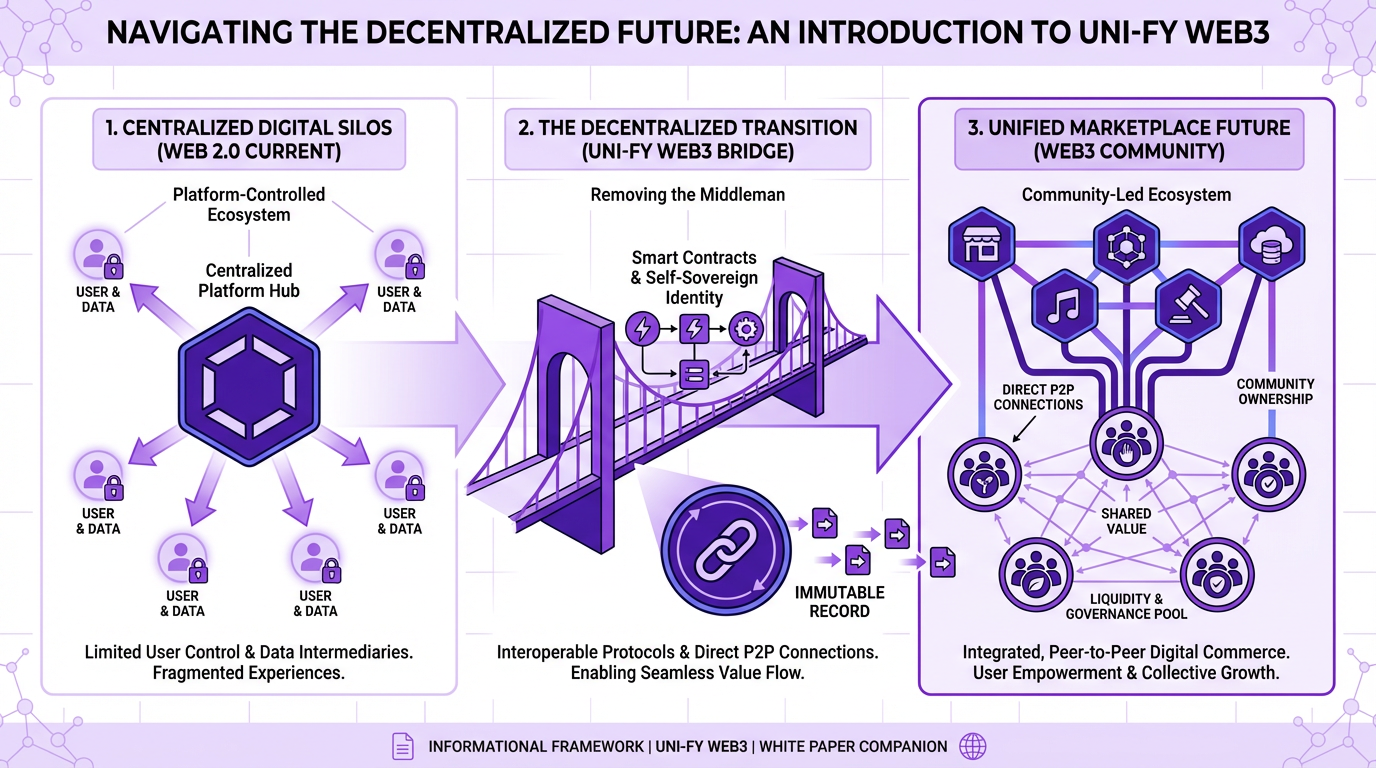
Navigating the Decentralized Future: An Introduction to Uni-fy Web3
Navigating the Decentralized Future: An Introduction to Uni-fy Web3
The internet is on the cusp of its next major evolution, transitioning from the centralized, platform-dominated Web2 to a decentralized, user-centric Web3. At the heart of this transformation lies uni-fy web3, a vision for an internet where users have greater control over their data, identity, and digital assets. This shift promises a more equitable and transparent online experience, moving away from the current model where a few tech giants hold immense power. For those seeking to understand these profound changes, our comprehensive uni-fy blog provides regular updates and in-depth analyses on the technologies and philosophies driving the Web3 movement.Uni-fy web3 is not merely a technological upgrade; it represents a fundamental rethinking of how we interact with digital services, conduct commerce, and build online communities. By leveraging blockchain, decentralized autonomous organizations (DAOs), and tokenization, it aims to create an internet that is open, permissionless, and owned by its users, rather than by corporations. This paradigm shift has significant implications for everything from digital identity to global finance.
Key Web3 Adoption Statistics • The number of unique active wallets interacting with decentralized applications (dApps) grew by over 400% in 2021 (DappRadar). • Over $25 billion has been invested in Web3 startups in the past two years, signaling strong investor confidence (Crunchbase). • 75% of internet users are concerned about their online privacy, driving demand for decentralized identity solutions (GlobalWebIndex). • The market capitalization of cryptocurrencies, a foundational element of Web3, surpassed $2 trillion in 2021 (CoinMarketCap).
The Foundational Technologies of Uni-fy Web3
Uni-fy web3 is built upon a stack of innovative technologies that collectively enable its decentralized vision. Understanding these core components is essential for grasping the potential and complexities of this new internet era.Blockchain and Decentralized Ledgers
At the core of Web3 is blockchain technology. This distributed, immutable ledger system provides the infrastructure for secure, transparent, and verifiable transactions and data storage without the need for a central authority. Blockchains enable the creation of cryptocurrencies, non-fungible tokens (NFTs), and smart contracts, which are the building blocks of decentralized applications (dApps). This foundational technology ensures that data ownership and transaction history are verifiable and resistant to censorship.| Web3 Component | Best For | Difficulty | ROI Potential |
|---|---|---|---|
| Decentralized Identity | User privacy, data control | Medium | High |
| Smart Contracts | Automated agreements, dApps | Medium | High |
| DAOs (Decentralized Autonomous Organizations) | Community governance, collective ownership | Hard | Very High |
| NFTs (Non-Fungible Tokens) | Digital ownership, creator economy | Medium | High |
The Promise of Uni-fy Web3: Empowering Users and Communities
The shift to uni-fy web3 promises a more empowering and equitable internet experience. By putting users in control, it fosters new models of ownership, governance, and value creation.The 5-Step Web3 Integration Framework
For businesses and creators looking to transition into the uni-fy web3 space, a structured approach can help navigate the complexities and maximize opportunities.Uni-fy Web3 and the Future of Digital Interaction
The implications of uni-fy web3 extend far beyond simple transactions. It envisions a future where digital interactions are more secure, private, and directly beneficial to the participants. This includes everything from how we manage our digital identities to how we consume and create content.Redefining Digital Ownership and Identity
Expert Insight: "The most profound shift with uni-fy web3 isn't just about owning digital assets; it's about owning your digital identity. In Web2, our identity is fragmented across countless platforms, each controlling our data. Web3 offers the promise of a self-sovereign identity, where you control your personal information and decide who accesses it. This fundamental change will redefine privacy, trust, and how we interact with every online service, making the user, not the platform, the central authority."With uni-fy web3, users gain self-sovereign identity, meaning they control their personal data and decide who can access it, rather than relying on third-party platforms. This enhances privacy and security significantly. Furthermore, NFTs enable verifiable digital ownership of everything from art to virtual real estate, creating new economies and opportunities for creators. This concept of verifiable ownership is also central to discussions around uni-fy dcommerce and its potential for new marketplaces.
Diagram: Uni-fy Web3 User Journey [User with Self-Sovereign ID] → [Interact with dApp] → [Execute Smart Contract] → [Own Digital Asset (NFT)] → [Participate in DAO Governance] → [Value Creation & Feedback to User]
The Challenges and Opportunities of Uni-fy Web3 Adoption
While the promise of uni-fy web3 is immense, its widespread adoption faces several challenges, including scalability issues, regulatory uncertainty, and the need for greater user education. However, these challenges also present significant opportunities for innovation and growth.Navigating the Transition
Transitioning to a uni-fy web3 paradigm requires careful navigation. Businesses and individuals must contend with evolving technologies, security considerations, and the learning curve associated with new concepts like wallets and gas fees. Yet, early adopters stand to gain a significant competitive advantage by shaping the future of decentralized internet services. The ongoing discussions and insights found within the broader uni-fy platform ecosystem are crucial for staying ahead in this rapidly evolving space.Frequently Asked Questions
What is the main difference between Web2 and uni-fy Web3?
Web2 is characterized by centralized platforms controlling user data and content, while uni-fy Web3 is decentralized, giving users ownership and control over their data, identity, and digital assets through blockchain technology and smart contracts.How does uni-fy Web3 enhance user privacy and security?
Uni-fy Web3 enhances privacy and security by enabling self-sovereign identity, where users control their data. Blockchain's cryptographic security ensures transactions are immutable and transparent, reducing reliance on centralized entities prone to data breaches.What are DAOs, and how do they fit into uni-fy Web3?
DAOs (Decentralized Autonomous Organizations) are organizations governed by rules encoded as smart contracts on a blockchain, without central leadership. In uni-fy Web3, DAOs enable community-driven governance, allowing token holders to vote on proposals and collectively manage projects or platforms.Can uni-fy Web3 solve the problem of digital content ownership?
Yes, uni-fy Web3 addresses digital content ownership through Non-Fungible Tokens (NFTs). NFTs provide verifiable proof of ownership for unique digital items, allowing creators to monetize their work directly and consumers to own digital assets in a way previously impossible.What are the biggest challenges to uni-fy Web3 adoption?
Key challenges include scalability limitations of current blockchain networks, regulatory uncertainty across different jurisdictions, the complexity of user experience for non-technical users, and the need for robust security against new types of cyber threats.Key Takeaways
- Uni-fy Web3 represents the next generation of the internet, emphasizing decentralization, user ownership, and transparency.
- Its foundation lies in technologies like blockchain, smart contracts, DAOs, and NFTs, enabling a more equitable digital landscape.
- Web3 promises to empower users with self-sovereign identity and verifiable digital ownership, redefining online interactions.
- A 5-step framework guides businesses and creators in understanding, experimenting with, and integrating Web3 principles into their strategies.
- Despite challenges, uni-fy Web3 offers significant opportunities for innovation, community building, and a more secure, private internet experience.